
The Real-World Brand Audit: What Customers Notice Before They Ever Contact You
One of the things I have been thinking about more lately is how much people decide about a business before they ever speak to anyone there. Most of the time, this happens quietly and people don't even notice they're doing it. Someone drives past a building, sees a company vehicle at a job site, walks through a front door, picks up a brochure, receives a quote folder, or notices what the staff are wearing, and evaluates.
This is easy to underestimate because we usually think of marketing as the things we intentionally send out into the world. We think about ads, websites, social media, brochures, mailouts, campaigns, signs, and trade show displays. Those things matter, of course, but they are only part of the picture.
A business also has a physical presence that is working all the time, whether anyone is paying attention to it or not.
The sign is working when the business is closed. The vehicle graphics are working when someone sees the truck in traffic. The front counter is working while a customer waits. The apparel is working when a crew walks onto a site. The business card or brochure is working after the meeting is over.
All of those physical pieces are shaping expectations, and expectations are a big part of your brand.
People Use What They Can See
No one will ever say, “I am evaluating your credibility based on your sign, your vehicle, your lobby, and your print materials.” But that is often what is happening.
People use shortcuts. They notice cues. They take small pieces of visible information and turn them into larger assumptions. Does this company look organised? Does it seem established? Does it feel current? Do they pay attention to detail?
Can I trust them with my money, my timeline, or my reputation?
A faded sign creates a small question. A vehicle with old graphics creates a small question. A messy front counter creates a small question. A brochure that feels out of date creates a small question. A team that looks inconsistent creates a small question. None of these things automatically ruins a reputation, but they can create friction. They make the customer work a little harder to believe the business is as good as it says it is.
On the other hand, while a clear sign, well designed brochure, and eye catching graphics do not prove a business does excellent work, they do help to remove doubt. It makes it easier for someone to believe the business is careful, stable, and worth talking to.
The Problem With Invisible Losses
Weak physical branding often does not show up as a complaint.
Customers do not usually call to explain that the exterior of the building made them hesitate. They do not email to say the handout felt cheap or confusing. They do not mention that the vehicle graphics made the company feel smaller or less established than it probably is.
More often, they just keep moving.
They do not call. They do not walk in. They do not remember the name. They do not take the quote as seriously as they might have. The business may never know what was lost.
That is why I have started thinking about some physical touchpoints as trust leaks.
A trust leak is not always obvious or ugly. It is just something in the customer’s experience that makes the business feel a little less credible than it should.
It might be an exterior sign that is technically still fine, but no longer reflects the quality of the company. It might be a truck that is doing good work all over town but has no branding on it. It might be a front door that does not clearly tell people where to go. It might be a brochure that explains what the company used to be instead of what it is now.
Not everything needs to be resolved right away. I know we've got some things we need to work on here at Strand, but being aware of it is half the battle.
Start With the Drive-By
A real-world brand audit does not need to be complicated. In many cases, it starts with something as simple as walking outside and looking at the business as if you had never seen it before.
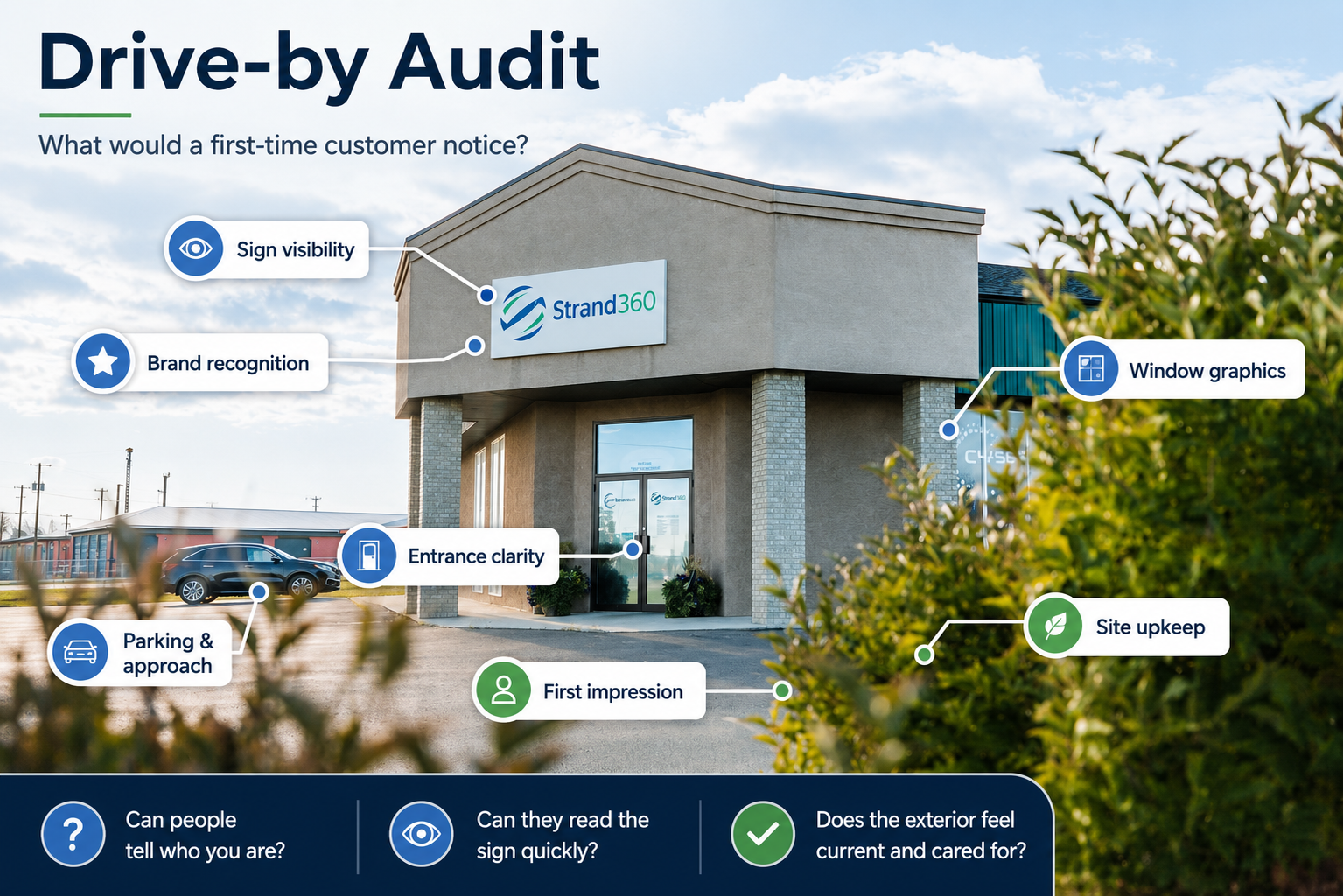
For local businesses, this matters because familiarity builds over time. A person may pass your location for months before they need what you sell. The question is whether your physical presence is making small deposits in their memory or disappearing into the background.
The same principle applies to vehicles. A marked vehicle can make a business feel more visible, more active, and more established. It tells people the company is out in the world doing work. A blank vehicle might still belong to an excellent business, but it misses a chance to build recognition.
Recognition is not a small thing. People often choose from the businesses that come to mind first, and physical visibility can help put a company into that mental shortlist before the buying process even starts.
Then Walk In Like a Customer
Once someone enters a space, the audit continues.
A reception area, front counter, pickup area, wall graphic, form, display, or sample wall all shape the experience. This does not mean every space needs to feel expensive or overly polished. It needs to feel intentional. People should know where to go, what to do, and what kind of business they have entered. A clear, cared-for physical environment reduces uncertainty. It quietly says there is a system behind the business and that someone has thought about the customer experience.
What a team wears can do the same thing.
Branded apparel is easy to dismiss as just clothing, but it often carries more weight than that. It creates recognition. It gives the team a shared identity. It helps customers understand who belongs to the business.
For a service company, a crew arriving in consistent apparel feels different than a crew arriving in whatever happened to be clean that morning. For a retail or front-office team, apparel can help customers know who to approach. For a company working on job sites, it can make the business feel more organised and professional before anyone says a word.
Again, the goal is not to look corporate for the sake of it.
The goal is to remove uncertainty.
Notice What Gets Handed Over
Some of the strongest brand moments happen when something changes hands. A business card. A quote folder. A brochure. A sample kit. A label. A package. A thank-you card. A leave-behind. These pieces can seem small, but they often have a longer life than a digital impression. They can sit on a desk, stay in a truck, hang on a fridge, get passed to another decision-maker, or end up in a file folder.
That physical moment matters because the customer is holding something connected to the business.
If it is useful, clear, and worth keeping, it can keep working long after the first conversation is over.
That is the difference between physical marketing that merely exists and physical marketing that earns its place.
A brochure should not just list services. It should help the customer think more clearly. A quote folder should not just hold paper. It should make the decision feel organised. A mailout should not just announce something. It should give the recipient a reason to pay attention. A leave-behind should not just carry a logo. It should help someone remember why the conversation mattered.
Look for the Pieces That Do Not Line Up
The other thing a real-world brand audit reveals is consistency, or the lack of it.
This is where many businesses quietly work against themselves.
One version of the logo appears on the sign. Another appears on the vehicle. A different colour palette shows up in the brochure. Old messaging is still on the business cards. The website looks like it belongs to a newer version of the company.
Internally, each of those pieces may have a reasonable explanation. They were ordered at different times. There was leftover stock. It was close enough. It did not feel worth replacing yet. But customers do not see the internal explanation. They see the results, and when the pieces do not line up, the business can feel less clear than it should.
Consistency does not mean every physical item has to look identical. A sign, a shirt, a vehicle wrap, and a brochure all have different jobs to do. But they should feel like they came from the same company.
Same level of care. Same basic visual language. Same promise. Same standard.
When those pieces work together, the business becomes easier to understand. And when a business is easier to understand, it is usually easier to trust.
The Goal Is Not More Stuff
The point of the audit is to create clarity for you about what physical marketing materials may need to be updated. You don't have to be perfect, or replace everything at once.
For one business, the biggest issue might be an exterior sign that no longer reflects the company. For another, it might be an unmarked vehicle. For another, it might be a confusing front counter, outdated print materials, inconsistent apparel, or a sales package that does not support the value of the work.
The right place to start depends on where customers are forming their strongest impressions.
A home service business may need to look first at vehicles, apparel, and job-site presence. A professional firm may need to look at its reception area, proposal package, and printed materials. A retailer may need to look at storefront signage, product displays, packaging, and in-store communication. A manufacturer or distributor may need to look at labels, catalogues, sample kits, and trade show materials.
The goal is not more stuff.
The goal is better signals.
Walk Through It With Fresh Eyes
Every business already has a physical presence. The only question is whether that presence is helping build trust or quietly leaking it. So it is worth taking the time to walk through the real-world touchpoints your customers see first.
Drive past your building. Walk in through the front door. Look at what a customer sees while they wait. Look at what your team wears. Look at what gets handed to someone after a meeting. Look at what old materials are still floating around.
Then ask a simple question: Does this make it easier to trust us?
If the answer is no, that is one place to start.
If you're finding this a bit overwhelming, we can help. At Strand360, we help businesses build trust where it matters most: in the physical world. From signs and vehicles to print, apparel, displays, and branded materials, we help your business show up clearly and consistently in the moments customers actually notice.
Because before someone chooses you, they have usually already started judging you.